1. Main Applications and Functions of Air Cooled Chillers
air cooled industrial blow molding chillers are used throughout multiple stages of blow molding, providing cooling for different equipment needs.
Mold Cooling: This is the most crucial application. Blow molding molds generate significant heat due to plastic melting and pressure during continuous operation. If not cooled promptly, this can lead to slow bottle cooling, deformation, and uneven wall thickness. Chillers remove this heat from the mold through water circulation, ensuring rapid preform shaping and maintaining dimensional accuracy and a smooth bottle appearance.
Extruder Cooling: In the extrusion blow molding process, the extruder heats and melts the plastic granules. Chillers cool the extruder barrel and screw, preventing localized overheating that could lead to plastic decomposition and carbonization, while also stabilizing melt viscosity and ensuring uniform extrusion volume.
Compressed Air Cooling: Blow molding requires high-pressure air to inflate the preform. The compressed air heats up during compression, and this high temperature affects the preform cooling and setting efficiency. A chiller cools the compressed air, shortening the bottle cooling time and increasing production speed.
2. Core Working Principle of air cooled blow molding chillers
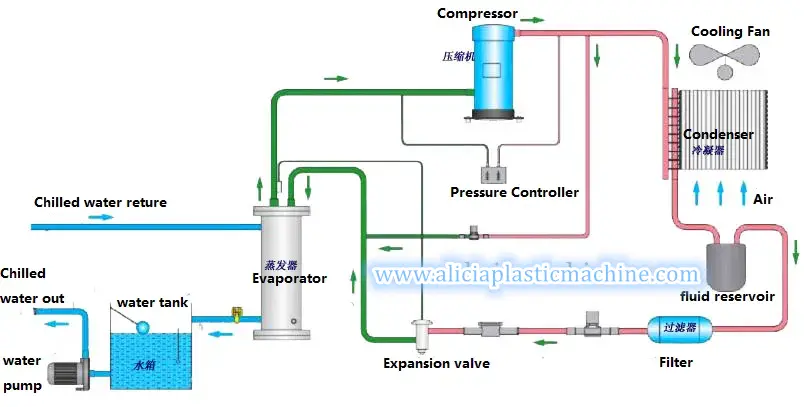
The chiller's workflow revolves around three steps: "refrigeration - circulation - heat dissipation," providing a stable cold source for the blow molding system.
Refrigeration Cycle: The compressor inside the chiller compresses the refrigerant into a high-temperature, high-pressure gas, which is then sent to the condenser for heat dissipation, becoming a low-temperature, high-pressure liquid.
Heat Exchange: The low-temperature liquid, after being throttled by an expansion valve, enters the evaporator, where it exchanges heat with the circulating water in the system, cooling the water to the set temperature (typically 5-15℃).
Cooling Application: The cooled circulating water is pumped to equipment requiring cooling, such as molds and extruders, where it absorbs heat and returns to the evaporator, completing one cycle.
3. Specifications of air cooled industrial blow molding chillers :
|
Model
|
Unit
|
AT-5AC
|
AT-6AC
|
AT-8AC
|
|
Cooling Capacity
|
|
KW
|
14.5
|
17.5
|
27
|
|
|
Kcal/h
|
12758
|
15054
|
23220
|
|
Compressor
|
Input Power
|
KW
|
3.75
|
4.5
|
6
|
|
Rated Power
|
HP
|
5
|
6
|
8
|
|
Power
|
|
3PH-380V/50HZ
|
|
Evaporator
|
Type
|
Shell and Tube
|
|
Pie Diameter
|
inch
|
1”
|
1”
|
2”
|
|
Refrigerant
|
Type
|
R22
|
|
Quantity
|
KG
|
2
|
2.5
|
4
|
|
Condenser(air chiller)
|
Type
|
Finned Copper Tube + Low Noise Outer Rotor Fan
|
|
Fan Power
|
W
|
180*2
|
180*2
|
420*2
|
|
Water Tank Capacity
|
|
Liter
|
45
|
45
|
80
|
|
Pump
|
Power
|
KW
|
0.75
|
0.75
|
1.5
|
|
HP
|
1
|
1
|
2
|
|
Distance
|
m
|
35
|
35
|
15
|
|
Flow Rate
|
L/min
|
110
|
110
|
360
|
|
Safety Protection
|
High and Low Pressure Protection, Overload Protection,Overtemperature Protection, Phase Sequence Protection,etc.
|
|
Dimensions(L*W*H)
|
|
mm
|
1280*680*1225
|
1280*680*1225
|
1550*850*1508
|
The core advantages of chillers for bottle blowing machines are to ensure product quality, improve production efficiency and reduce comprehensive costs through stable temperature control, which is embodied in four key dimensions.
1. Ensure blow bottle molding quality, reduce defective rate
Precise control of the mold temperature (stable at 20-30°C) allows the bottle blank to be quickly and uniformly shaped, avoiding bottle body deformation, uneven wall thickness, bottle mouth shrinkage and other problems, improving dimensional accuracy and appearance smoothness.
Cool the compressed air to 2-5°C and remove water vapor to prevent high temperature air from affecting styling or water vapor residue causing water marks in the bottle, especially suitable for the cleanliness requirements of food-grade blow bottles.
Stabilizes the temperature of the extruder barrel, avoids plastic decomposition, carbonization, ensures uniform melt viscosity, reduces bottle impurities, air bubbles and other defects.
2. Improve production efficiency and ensure continuous operation
Accelerate the cooling rate of the mold and bottle blank, shorten the molding cycle, single bottle production time can be reduced by 10%-30%, multi-cavity bottle blowing machine more effective.
Reduce the probability of equipment failure due to high temperature, reduce downtime and maintenance time, while avoiding the thermal expansion of the mold affecting the smoothness of opening and closing the mold, ensuring the continuous operation of the production line.
Adapts to load fluctuations of multiple bottle blowers or multi-cavity equipment to support high-capacity continuous production needs by stabilizing the output of cooling volume.
3. Reduce integrated production costs and balance energy saving
Modern chillers have high energy efficiency ratios, reducing energy consumption by 20%-40% compared to natural cooling or simple cooling methods, which can save a lot of electricity bills for long-term use.
Reduces thermal wear and aging of parts such as molds and extruders, extending the service life of equipment and reducing replacement and maintenance costs.
Reducing the waste of raw materials caused by the rework of defective products, especially for high-priced raw materials such as PET, can significantly reduce the cost of raw material loss.
4. Strong adaptability, convenient operation and maintenance
Flexible selection of bottle blowing machine type (extrusion blow molding/injection pull blow molding), number of cavities, and production capacity can be used to support customized cooling solutions.
Equipped with PID intelligent temperature control system, the water temperature precision is controlled at ±0.5-1°C, without the need for frequent manual adjustment, simple operation.
The structural design is compact, some models adopt 304 stainless steel water tank, easy to remove access door, easy maintenance, and can avoid waterway rust.