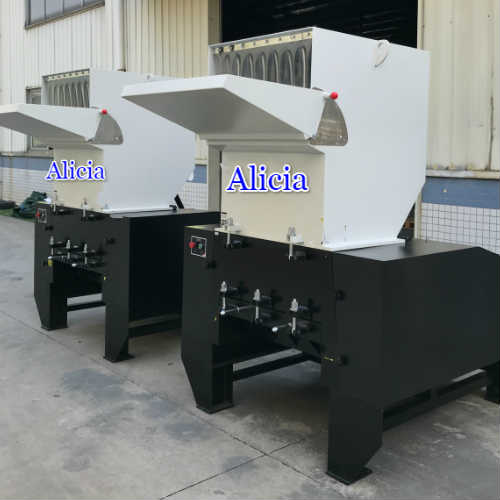
The claw-shaped blade assembly is the heart of this machine, distinguishing it from conventional straight-blade or hammer-blade crushers. This design is engineered to address the unique challenges of plastic processing, offering four critical benefits:
Claw blades feature a curved, hook-like profile with sharpened edges and a pointed tip, enabling them to grip, pierce, and tear a wide range of plastics. For rigid plastics (e.g., thick HDPE sheets, PVC pipes), the claw tips penetrate the material surface, reducing the force needed to break it down. For flexible plastics (e.g., LDPE film, PP bags), the curved edges guide the material into the cutting zone, preventing slippage that often plagues flat blades. This versatility eliminates the need for multiple crushers for different plastic types.
Traditional crushers struggle with plastics that vary in size or thickness—for example, a single batch may include small injection molding scraps and large plastic drums. The claw blade’s design adapts to this variability: its wide contact area handles large items, while the precise tip targets small, hard-to-reach fragments. A standard claw blade crusher can process plastics ranging from 1mm-thick film to 10mm-thick HDPE blocks, with no need for pre-sorting by size.
Plastics—especially flexible or sticky types (e.g., TPU, soft PVC)—are prone to wrapping around rotors or clogging crushing chambers. The claw blade’s design mitigates this: the space between adjacent claws allows air circulation, preventing material tangling. As the rotor spins, the claws also scrape residual plastic from the chamber walls, creating a self-cleaning effect. This reduces unplanned downtime for jam clearing, increasing overall operational efficiency by 20-30% compared to traditional crushers.
Claw blades are crafted from high-performance alloy steels (e.g., Cr12MoV, SKD11) and undergo precision heat treatment (quenching and tempering) to achieve a surface hardness of HRC 60-63. This hardness resists wear even when processing abrasive plastics (e.g., glass fiber-reinforced PP, filled PVC). Under standard operating conditions, the blades maintain sharpness for 1,200-1,800 hours of continuous use—twice as long as standard straight blades—lowering maintenance costs and replacement frequency.
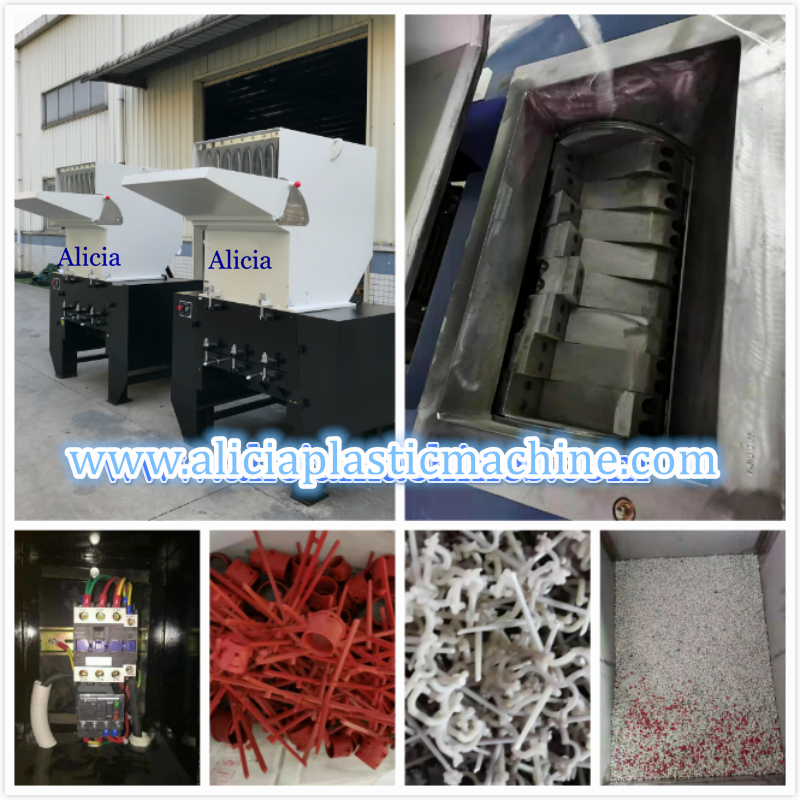
Core Capabilities
2.1 Multi-Material Processing
The Claw Blade Plastic Crusher Machine excels at handling diverse plastic types, making it a one-stop solution for facilities with mixed inputs:
Rigid Plastics: HDPE crates, PVC pipes (up to 300mm diameter), ABS electronic housings, PET preforms, PP automotive components, and nylon industrial parts.
Flexible Plastics: LDPE agricultural films, PP packaging bags, plastic sheeting, TPU scraps, and soft PVC products (e.g., cable insulation).
Fresh & Waste Plastics: Both post-consumer waste (sorted bottles, containers) and post-industrial scraps (extrusion trim, injection molding runners, defective plastic parts).
This versatility eliminates the need to invest in multiple specialized crushers, reducing capital expenditure and saving workshop space.
2.2 Adjustable Fragment Size Control
To meet the needs of downstream processes, the machine offers precise control over fragment size via replaceable screen meshes (available in 10mm-50mm sizes). Key configurations include:
10-20mm Meshes: For fragments destined for granulation, where uniform small sizes ensure efficient pellet production.
25-35mm Meshes: Ideal for feedstock in extrusion processes (e.g., pipe, profile manufacturing), balancing material flow and melting efficiency.
40-50mm Meshes: Suited for large-scale extrusion or pyrolysis applications, where larger fragments reduce processing time without compromising end-product quality.
The screen mesh is mounted on a quick-release frame, allowing operators to swap meshes in 15-20 minutes—no specialized tools required—enabling fast adaptation to changing production needs.
2.3 High-Volume Processing
With processing capacities ranging from 150 kg/h (small-scale models) to 2,000 kg/h (industrial-grade units), the machine scales to match facility demands:
Small-Scale Models (150-500 kg/h): Designed for workshops, small recycling facilities, or manufacturing units with low to moderate plastic scrap volumes. They feature compact dimensions (2,000×1,500×2,500 mm) to fit space-constrained environments.
Industrial Models (1,000-2,000 kg/h): Built for large recycling plants, waste management facilities, or major manufacturing sites. These units include reinforced steel frames (10-16mm thick) for stability and integrated conveyor systems for continuous feeding/discharge.
2.4 Integrated Safety & Protection Systems
Given its high-torque operation, the machine prioritizes operator safety and equipment protection with:
Interlocked Safety Guards: Covers for the hopper, rotor, and discharge area that automatically shut down the machine if opened—preventing access to moving parts.
Emergency Stop Buttons: Strategically placed on the control panel and machine frame for immediate shutdown in case of jams or hazards.
Overload Protection: A torque limiter or variable frequency drive (VFD) that reduces motor speed or stops operation if the machine encounters excessive resistance (e.g., metal contaminants in plastic). This protects the motor, blades, and rotor from damage.
Heat Dissipation: Motor housings with built-in cooling fans to prevent overheating during extended operation—critical for high-volume processing.
Application Scenarios
3.1 Plastic Manufacturing Units
Injection molding, extrusion, and blow molding facilities use the machine to process fresh plastic scraps (e.g., runners, trim, defective parts) on-site. By crushing these scraps into fragments, facilities can reuse up to 30% of their plastic input—reducing reliance on virgin resin and lowering production costs. For example, an extrusion plant producing PVC pipes can crush trim edges and mix the fragments with virgin PVC to make new pipes.
3.2 Plastic Recycling Facilities
Recycling plants rely on the machine as a pre-processing step before granulation or washing:
- Rigid Plastic Recycling: Crushing HDPE crates or PET bottles into 20-30mm fragments for efficient washing (to remove labels or dirt) and granulation.
- Flexible Plastic Recycling: Tearing LDPE agricultural films into small pieces to facilitate washing and drying, improving the quality of recycled film granules.
- Mixed Plastic Recycling: Breaking down sorted post-consumer waste into fragments that can be further sorted by material type (via optical sorters) before granulation.
-
3.3 Waste Management Centers
Municipal and industrial waste management facilities use the machine to reduce the volume of plastic waste by 70-80%, making transportation to recycling plants more cost-effective. It also prepares oversized waste (e.g., plastic furniture, large containers) for sorting, as smaller fragments are easier to handle with automated sorting equipment.
3.4 Specialty Plastic Processing
- Automotive Industry: Crushing waste ABS bumpers, PP interior panels, and HDPE fuel tanks into fragments for recycling into non-critical components (e.g., cable ties, wheel liners).
- Electronics Industry: Processing defective ABS or PVC electronic housings into clean fragments, which are recycled to recover valuable plastics and reduce e-waste.
- Pyrolysis Plants: Converting plastic waste into 30-50mm fragments for consistent feeding into pyrolysis reactors, improving fuel yield and reaction efficiency.