Linear Vibrating Screen/Rectangular Vibrating Screen
A linear vibrating screen is a screening device that uses a vibrating motor to generate linear reciprocating vibration on the screen surface, enabling efficient classification, impurity removal, or dewatering of materials. It is widely used in large-scale material processing scenarios due to its stable operation and high throughput.
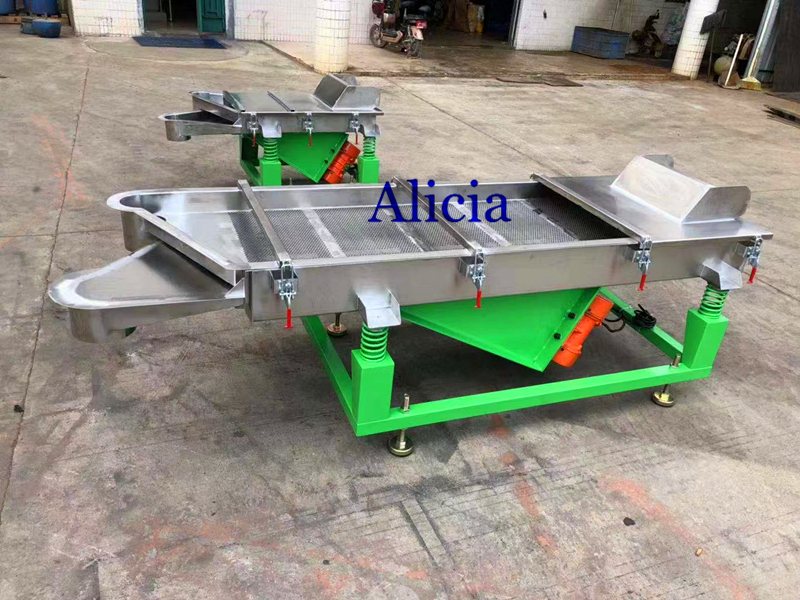
Specifications for vibrating screen
Output: 300 kg/h
The size of the area with holes: length 940mm, width 370mm [count the top 440mm], overall width 600mm, length 1.3 meters
Material: 304 stainless steel plate
The first layer of mesh 8mm
The second layer 2.0mm
Thickness 1.5mm
Motor 0.12kw Voltage: 380V/3phase/50hz
The feed inlet is 60 cm above the ground (adjustable range +-8 cm) Machine weight: 120KG
Core Working Principle of linear vibrating screen
The linear vibrating screen relies on two vibrating motors installed symmetrically. These motors rotate in opposite directions at the same speed, generating a combined force that drives the screen box to perform linear reciprocating motion along the direction of the material flow.
Materials are evenly fed onto the screen surface through the feed port.
Under the action of linear vibration, materials move forward in a jumping manner on the screen surface.
Materials with particle sizes smaller than the screen mesh fall through the screen (undersize material), while larger particles continue moving forward and are discharged from the end of the screen (oversize material), completing the screening process.
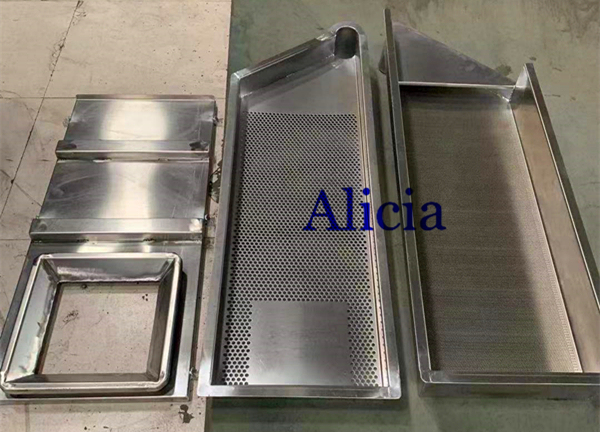
Key Features of linear vibrating screen
High Throughput: The linear motion of the screen surface promotes rapid forward movement of materials, making it suitable for large-volume material processing, with a higher handling capacity than circular vibrating screens.
Stable Screening Precision: The uniform linear vibration ensures consistent contact between materials and the screen mesh, reducing missed screening or over-screening and maintaining stable precision (usually 1-600 mesh).
Adjustable Vibration Parameters: The amplitude and vibration frequency can be adjusted by replacing the eccentric blocks of the vibrating motor, adapting to different material properties (such as viscosity, particle size).
Diverse Screen Surface Options: The screen mesh can be made of metal wire, polyurethane, or stainless steel, and supports multi-layer design (1-5 layers) to achieve multi-level classification of materials at one time.
Typical Application Scenarios of linear vibrating screen
Linear vibrating screens are widely used in industries that require large-scale and continuous screening, mainly including:
Mining & Metallurgy: Screening crushed ores (such as iron ore, copper ore) and separating useful minerals from gangue.
Building Materials: Classifying sand, gravel, cement, and concrete aggregates to ensure the particle size meets construction standards.
Coal Industry: Dewatering, desliming, or grading coal, clean coal, and coal slime.
Food & Chemical: Screening granular materials (such as grains, fertilizer, plastic particles) for impurity removal or particle size grading.


